Frameless Torque Motors Across Robot Platforms
From AGVs and AMRs to Humanoid and Quadruped Robots
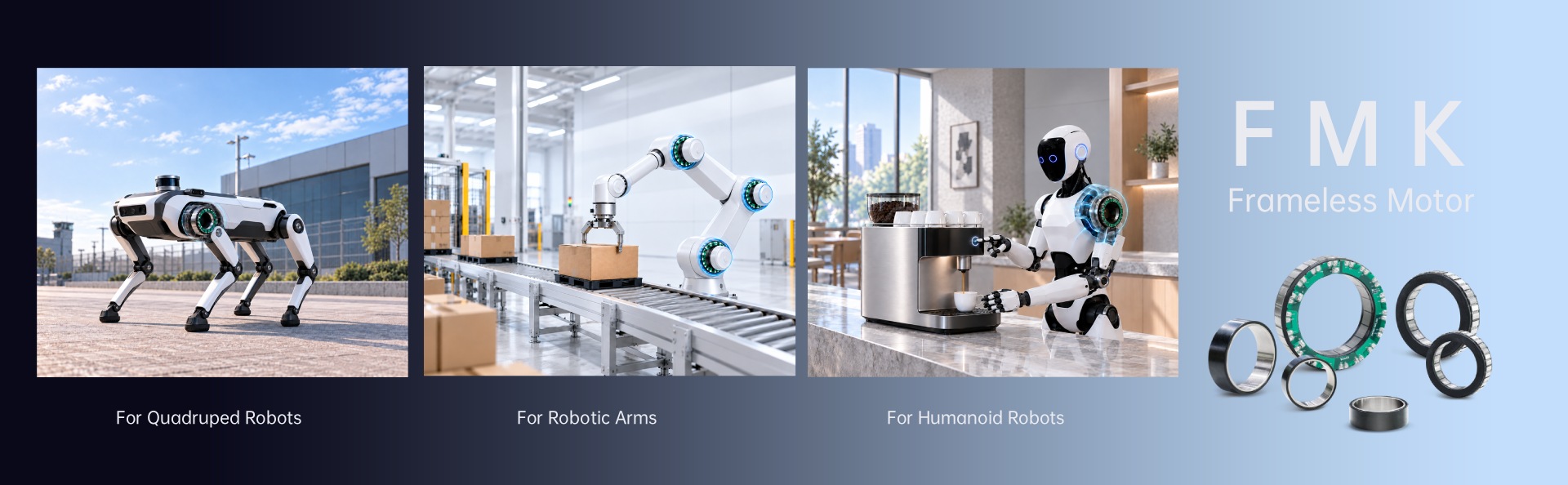
As mobile robotics and embodied AI advance, frameless torque motors are moving beyond their established role in collaborative robot joints and into automated guided vehicles (AGVs), autonomous mobile robots (AMRs), wheeled humanoids, bipedal humanoids, and quadruped robots. These platforms differ significantly in load, speed, available joint space, and thermal conditions. Their motor requirements therefore differ as well.
1. AGVs and AMRs Prioritize Reliability and Continuous Duty
AGVs and AMRs primarily handle material transport, logistics, and flexible manufacturing tasks. Their motion systems typically rely on hub drives, swerve drive modules, or steering actuators. Compared with legged robots, these applications place less emphasis on short-duration peak performance. Instead, they prioritize continuous-duty operation, low temperature rise, high efficiency, and consistent service life.
In compact swerve drive modules, a frameless torque motor can be built directly into the actuator. Eliminating a separate motor housing reduces the installation envelope, which can lower module height and increase integration. AGVs and AMRs are therefore well suited to frameless motor designs optimized for low-to-medium speeds, stable continuous torque, and proven thermal performance.
2. Wheeled Humanoid Robots Balance Dexterity and Cost
Wheeled humanoid robots combine upper-body dexterity with lower system complexity and cost. A wheeled base eliminates the need for complex bipedal gait control, so most of the robot’s degrees of freedom are concentrated in the waist, shoulders, elbows, and wrists. Shoulder and waist joints generally require higher torque, while elbow and wrist joints place greater emphasis on low mass and compact dimensions.
A single wheeled humanoid may therefore use frameless torque motors with several outer diameters and torque ratings. Because this architecture requires fewer highly dynamic leg joints than a bipedal robot, designers place greater emphasis on modularity, cost control, and platform-based product families spanning multiple sizes. These characteristics also make wheeled humanoids well suited to volume deployment of frameless torque motors.
3. Bipedal Humanoid Robots Demand High Torque Density and Low Mass
Bipedal humanoid robots are among the most demanding applications for frameless torque motors. They must walk, stand up, climb stairs, and in some cases run or jump. Their hip, knee, and ankle joints are repeatedly exposed to substantial impact loads, placing much higher demands on actuator performance than most industrial robots.
Motor evaluation for these applications typically focuses on torque density, peak torque, continuous torque, motor mass, temperature rise, and overload capability. Hip and knee joints require high output torque without significantly increasing leg inertia. Large through-bores, high slot fill factors, high torque density, and lightweight construction are therefore important development priorities for bipedal humanoid motors.
As robotic joint actuators become more integrated, designers must also consider the system-level matching of the motor, gearbox, encoder, and servo drive. The performance of the complete actuator increasingly depends on how well these components work together.
4. Quadruped Robots Emphasize Dynamic Response and Impact Resistance
Quadruped robots frequently accelerate, decelerate, jump, and adjust their posture. Their leg joints therefore operate under highly dynamic conditions with frequent start-stop cycles. Compared with motors used in conventional robotic arms, quadruped joint motors require high torque density as well as rapid response, strong overload capability, and effective thermal management.
Each quadruped robot also contains multiple leg joints, so motor mass directly affects battery runtime and dynamic performance. Lightweight construction is therefore a core design requirement alongside torque output and impact resistance.
5. No Single Motor Design Fits Every Robot Platform
Frameless torque motors are moving toward platform-based product architectures, but there is no single design that is optimal for every robot. AGVs and AMRs prioritize continuous operation and reliability. Wheeled humanoids focus more on cost and the ability to support several motor sizes. Bipedal humanoids require high torque density and low mass, while quadruped robots place greater emphasis on dynamic response and overload capability.
6. From Custom Motors to Scalable Product Platforms
As robot joint dimensions become more standardized, frameless torque motor development is likely to shift from one-off models toward broader product families, shared platforms, and more tightly integrated joint actuators. Product portfolios that cover multiple outer diameters and power ratings while also providing through-bore cable routing, low temperature rise, and consistent batch-to-batch quality will be better positioned to support volume deployment across different robot platforms.